top  


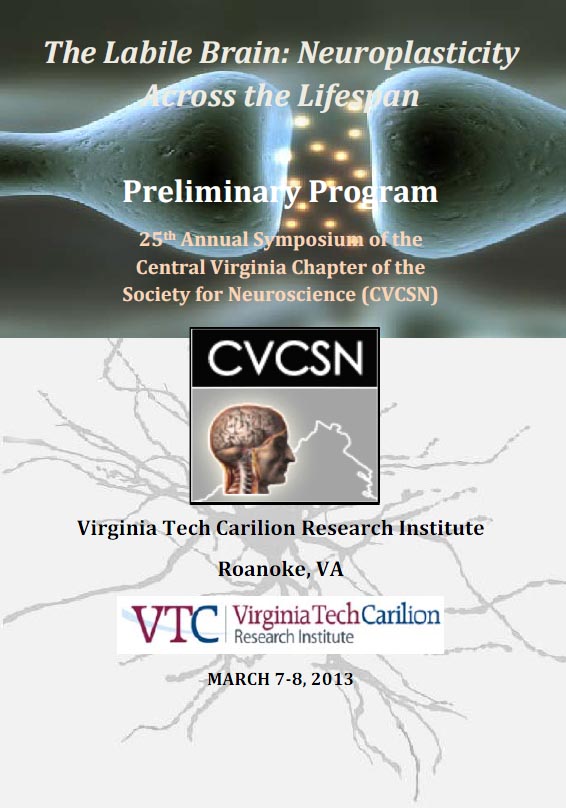
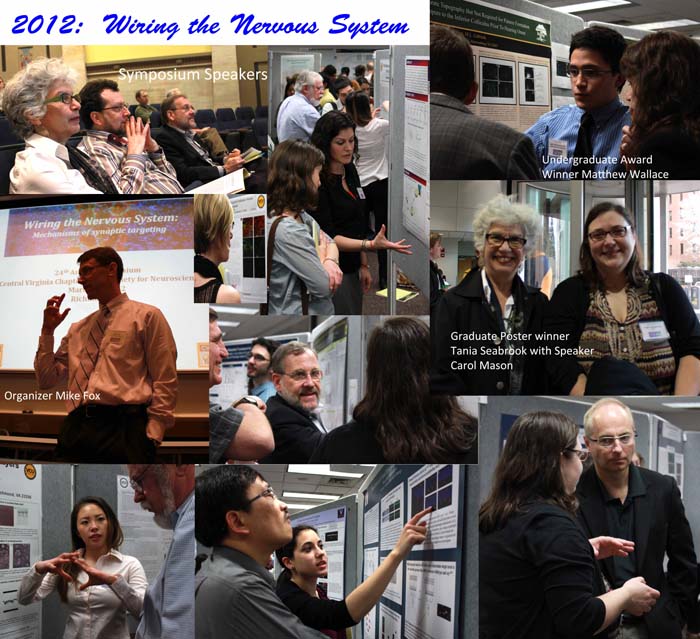
Friday, March 16th 2012 (all day) Annual Symposium - Wiring the nervous system -  Mechanisms of synaptic targeting and synapse formation


CLICK HERE FOR REGISTRATION FORM


Previous Events:


Brain Day
: Monday, March 14, VCU (Commonwealth Ballroom, Student Commons)

     The VCU Biopsychology program hosted the 5th annual Brain Day Conference in conjunction with National Brain Awareness Week.  The conference featured two guest speakers and a poster/demonstration session by the 200 high school student participants.  Brain Day is a unique one-day conference on topics related to the brain and behavior and is a partnership between VCU Biopsychology Program and Henrico County Public Schools (HCPS).  Attending were AP Psychology students from Hermitage H.S., Godwin H.S. and the VCU dual-enrollment students at the Maggie L. Walker Governor’s School who take the VCU psychology course Physiological Psychology (PSYC 401).  This year’s featured speakers were Jill Bettinger, PhD, Assistant Professor, Department of Pharmacology & Toxicology, VCU who spoke on “What Drunk Worms Can Tell Us about Drinking: the Molecular Neurobiology of Ethanol Response” and Kelly G. Lambert, PhD, Professor and Chair, Department of Psychology, Randolph-Macon College who spoke on “Prehistoric Prozac: Lessons From the Trust Fund Rats.”    The student participants presented over 50 posters on various topics related to the neurobiological basis of behavior such as: depression, synesthesia, emotions, addiction, taste preferences, visual procession, attention and the brain and music.  Of special interest were the student demonstrations of neural firing of cockroach limbs using “Spiker boxes” in which students can actually hear neuronal firing and visually see it on computer sine wave programs.  The conference was directed by Joseph H. Porter, PhD and Tim Donahue, graduate student in Biopsychology.

Thanks to all for another great CVCSN symposium!

See below for pics and summary of this year's event 
Neuroengineering:  Insights from Brain-Machine Interfaces

(click for Program)

March 18th, 2011  9 AM - 5 PM

Thanks to Les Keniston for the photos

The Central Virginia Chapter of the Society for Neuroscience (CVCSN) held its 23rd Annual Neuroscience Symposium  “Neuroengineering:  Insights from Brain-Machine Interfaces (BMIs)”    on March 18, 2011 in the MCV Alumni House Conference Center at Virginia Commonwealth University.   The symposium reviewed  the initiatives being taken  toward restorative medicine, aimed at allowing  amputees/ paralytics to use their own brain signals to drive computer-controlled prosthetics.  Specific components of this process were addressed by the different speakers.  The lead-off speaker for the symposium was  Peter Pidcoe, PT, Ph.D. and biomedical engineer in VCU’s Department of Physical Therapy who provided a comprehensive overview of the history and variety of prosthetic devices as well as their design and effectiveness.  Next, to understand the brain signals that control movement in normal limbs or robotic prostheses, Andrew Schwarz Ph.D. from the University of Pittsburgh demonstrated that signals from populations of cortical neurons in a monkey can effectively drive a robotic arm.  A video of a monkey feeding itself in this way is available on YouTube (http://www.youtube.com/watch?v=pz_DV7elpxw&feature=related).  For neural signals to drive prostheses, those signals must be converted into computer language and neuro-computationalist Tom Anastasio ,Ph.D. (University of Illinois-Champlain) explained the mathematical bases of neural signaling.  However, to send a computer neural messages from a living brain, there must be an artificial interface that is implanted into neural tissue.  This was addressed by Patrick Tresco, Ph.D. and Chair of Biomedical Engineering at the University of Utah  who showed that long-term electrode implantation can be optimized by engineering electrodes with novel geometries and coatings.  To summarize how BMIs are used by and affect patients, Col. Geoffrey Ling MD, Ph.D., Chair of Neurology at Uniformed Services University of the Health Sciences and program manager at DARPA, not only presented a compelling justification for this collaboration between biomedical research and engineering, but also showed numerous film clips of patients successfully manipulating their new prosthetic limbs.  The conference was attended by 80 VCU faculty and students, faculty from Virginia Union University, as well as a contingent of biomedical engineering students from the University of Virginia.   For more information about this event, contact:  Alex Meredith (mameredi@vcu.edu) or Ruth Clemo (rclemo@vcu.edu).

Design and construction of biomechanical therapeutics 
Peter Pidcoe, PT, Ph.D,   
Department of Physical Therapy, Virginia Commonwealth University, Richmond, VA

Neural Encoding of movement and intention 
Andrew B. Schwartz, Ph.D., 
University of Pittsburgh, Department of Neurobiology, Pittsburgh, PA

Neurocomputation, how to get Instructions from neurons into machines? 
Thomas J. Anastasio, Ph.D., 
Beckman Institute of NeuroTechnology, University of Illinois, Urbanna, IL

Biocompatibility and bio/implant interface
Patrick A. Tresco, Ph.D., 
Department of Bioengineering, University of Utah, Salt Lake City, UT

Patient application of Brain-Machine Interfaces 
Geoffrey S.F. Ling, MD, Ph.D., 
Colonel US Army Med Corps, Department of  Neurology, Uniformed Services University of the Health Sciences, Bethesda MD